Michael Poris: Revitalizing Detroit Through Adaptive Reuse
Key Highlights
- Poris returned to Detroit in 1994 and has helped lead its architectural revitalization for three decades.
- His projects include Fisher Body 21 Lofts, the Detroit Foundation Hotel, and Amsterdam Lofts.
- He favors contemporary additions that complement historic structures while keeping original features legible.
- Historic tax credits and clear financial comparisons can help make preservation competitive with new construction.
- Poris sees adaptive reuse as a way to sustain Detroit’s character, community, and collective memory.
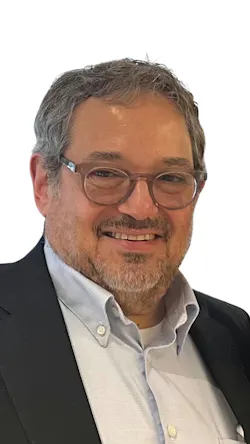
After growing up in Detroit in the 1960s, Michael Poris left his hometown to pursue a degree in architecture, eventually landing in Los Angeles where he worked under starchitects like Frank Gehry, Richard Meier, and Thom Mayne.
Meanwhile his native Detroit, once a bustling metropolis fueled by the automotive industry, continued declining, leaving behind a graveyard of abandoned buildings.
In 1994, Poris’ childhood friend Doug McIntosh convinced him to return to Detroit to help rebuild the city, beginning a 30-year journey of rescuing old industrial and period buildings from the wrecking ball. His efforts have fueled reinvestment and revitalization of the Motor City and earned 130 design awards in the process.
Poris and McIntosh began their new initiative by organizing events to bring revitalization experts from other cities to speak to Detroit business leaders, developers, and government officials.
“One of our biggest [early] wins was getting Historic Districts re-zoned for mixed use, opening the door to residential and retail redevelopment,” he recalls.
The pair built up McIntosh Poris Architects until McIntosh’s unexpected death in 2006. Poris continued the legacy and in 2022, was awarded the prestigious AIA Michigan Charles Blessing Award in recognition of his decades of devotion to Detroit preservation.
The list is long, but a few noteworthy projects include the Fisher Body 21 factory conversion to apartments, transforming the 1929 Detroit Fire Department headquarters into the Detroit Foundation boutique hotel, designing the Motown Museum with Perkins&Will, and working on the East Riverfront masterplan with SOM, creating waterfront access from the Renaissance Center to the Belle Isle Bridge.
A Lesson in Reuse
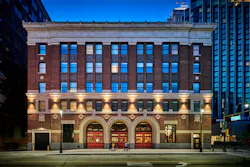
Picking up some pointers from the master in adaptive reuse, Poris begins every project with zoning and program to determine how the new use fits within the structure. As a rule of thumb, his team designs in contrast as opposed to mimicking the existing building.
“The new elements should stand out as clearly of our time while complementing and balancing the historic fabric,” he says. “The Secretary of the Interior’s Standards generally favor this approach so that original elements remain legible. I think of it like a collage—a Rauschenberg, if you will—where layers of old and new create something richer and more interesting.”
Poris often selects indigenous Detroit materials like brick, limestone, and wood to help ground the project in its context.
Sharing a couple best practices, he recommends demonstrating financial viability with real numbers and precedents. This can include showing how historic tax credits, brownfield credits, and other incentives can make preservation competitive with—or better than—new construction.
He advises capturing strong before/during/after photography and sharing it widely as visual stories help people see the potential.
Stories of Success
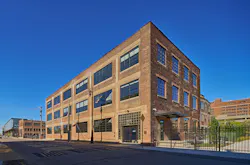
A great example of turning an abandoned industrial structure into new property is the Fisher Body 21 Lofts, formerly a 600,000-square-foot factory that produced Cadillac and Buick car bodies from 1919 to 1984. After sitting vacant for nearly three decades, Poris’ team worked with a developer to convince the city that the building was worth saving.
“Once work began, much of the damage proved cosmetic and after peeling back layers, it was found to be structurally sound. Renovation costs with tax credits were roughly half of what comparable new construction would be,” he stated.
Another Poris favorite is the recovery of Cadillac’s first assembly line into the 90-unit Amsterdam Lofts. Of significance, the structure is one of the first industrial buildings made with a Kahn Bar concrete-reinforcing system, a significant advancement in its day, pioneered by Julius Kahn, the brother of architect Albert Kahn.
“This concrete advancement improved fire protection, reduced floor vibration on the assembly line, and enabled wider open interior spans,” he says.
For Poris, his dedication to Detroit’s adaptive reuse and historical restoration efforts has been a win-win. “The most rewarding part is making a real difference in the community where I live and work. By saving and revitalizing historic buildings, we keep the city’s authenticity and memory alive,” he concludes.