Redmond Library Uses Mass Timber to Cut Embodied Carbon

Careful material choices cut the library’s embodied carbon 52% below the industry average for comparable materials; mass timber stores carbon equivalent to nearly half of construction emissions.

Key Highlights

  • Hybrid queen post trusses combine double glulam beams and steel rods to create a flexible 65-foot span.
  • Acoustic dowel laminated timber uses hardwood pegs and sound-absorbing insulation to deliver acoustic comfort with much of the wood left exposed.
  • Tally for Revit helped the team assess embodied carbon and guide material selections.
  • Low-carbon concrete mixes and reduced concrete use lowered global warming potential by 26%.
  • Miller Hull purchased Green-e certified offsets for a portion of the project’s embodied emissions.

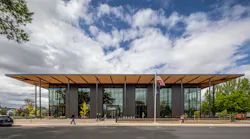
There's a new 38,000-sq.-ft. library in Redmond, OR, that, in itself, is a great story about designing projects to achieve low embodied carbon goals and its told by the project's architectural team at Miller Hull. 

"The structural system you use—wood, concrete, or steel—really impacts the amount of embodied carbon on the project," says John MacKay, AIA, Principal, The Miller Hull Partnership. The mass timber used in this building stores enough carbon to offset nearly half of all the carbon emitted to construct it.

For the Redmond Library, the firm suggested mass timber early on in discussions with the client. The team designed hybrid queen post trusses, composed of double glulam beams and steel rods, to deliver an impressive 65-ft. span, which gave the interior of the library a lot of flexibility to change the future layouts as the library's needs evolve. 

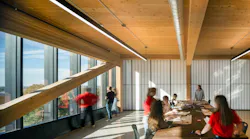
"Mass timber checked a lot of different boxes—from that warm and welcoming feel to acoustic performance," says MacKay. In addition to glulam post and beams, the project used acoustic dowel laminated timber (ADLT) for the structural deck, which is left exposed as the ceiling. ADLT is glueless (held together with hardwood pegs) and has grooves cut into the bottom of the wood profile to receive sound-absorbing insulation, making spaces quieter while preserving the look of natural wood.

"This particular type of mass timber—ADLT—is perfect for libraries. The acoustic material makes the space very comfortable for users," he adds. "We have 80% of the ADLT exposed. That warmth did not have to be covered with an additional acoustic material."

"Miller Hull has a long history of expressed structure," explains McKay, "Anyone coming into the library can see the glulam columns and beams, as well as the wood deck, on full display."

The team used tools like Tally for Revit to calculate embodied carbon, leading to carefully selected building materials (mass timber included) to achieve reduction goals.

Considering only the building's major structural and finish materials, Redmond Library's embodied carbon is 52% lower than the industry average for similar materials, as tracked by the industry-standard Carbon Leadership Forum's 2023 database. Simply reducing the amount of concrete and opting for low-carbon mixes resulted in a 26% reduction in Global Warming Potential. 

Additionally, through its EMission Zero initiative, Miller Hull has voluntarily purchased Green-E certified carbon offsets to cover a portion of the built project's embodied emissions. 

Compared to a code-compliant library of similar size and type—the standard benchmark used in LEED green building certification—Redmond Library was built with 61% less embodied carbon.

About the Author

Jana Madsen

Jana Madsen is an experienced communications and marketing professional with more than 20 years of expertise in writing, editing, and content strategy developed through reporting on and working within the AEC industry. Through her work with D. C. Taylor Co., freelance clients such as Architectural Products magazine, and previous editorial leadership with BUILDINGS magazine, she's developed a strong ability to collaborate with subject-matter experts, manage creative projects, and translate complex ideas into clear, engaging, and accessible content.

Her work is grounded in a clearly defined editorial process that includes research collection, source interviews, transcript review, organization of supporting materials, and careful content development. She is committed to communicating clearly, accurately, and with integrity, always striving to present the full story in a way that resonates with both technical experts and laypersons. Known for meeting word counts and deadlines while maintaining exceptionally high standards, she relentlessly pursues details that elevate the quality, clarity, and credibility of the final piece.

Sign up for our eNewsletters
Get the latest news and updates