Redmond Library: A Net-Zero Neighbor

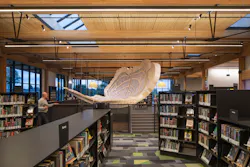
Miller Hull designed the rooftop to host a 297-kW solar array and rows of triple pane, low-e skylights to help meet the net zero project goal and offer incredible daylighting and views.

Key Highlights

  • The 38,000-square-foot library features an all-electric, high-efficiency air-water heat pump array and DOAS ventilation system.
  • Its walls achieve Passive House-level thermal performance, with a U-value of 0.044.
  • A rooftop array of 510 Qcell photovoltaic panels has an estimated annual production of 373,655 kWh.
  • Triple-pane, low-e skylights and a 40% window-to-wall ratio support daylighting while balancing envelope performance.
  • The design achieves 43% Spatial Daylight Autonomy, views from 99% of interior spaces, and a 44% reduction in lighting power density.
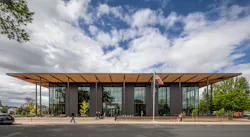
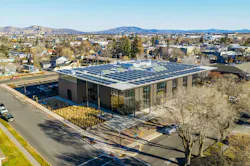
Set within a historic district in Redmond, OR, and adjacent to a residential neighborhood, the new 38,000-sq.-ft. Redmond Library was designed by Miller Hull Partnership to be a good, net zero neighbor. 

"This has been a great owner and their goal was an all-electric building," says John McKay, AIA, Principal, Miller Hull Partnership. "Removing fossil fuels from building operating systems is one of the best things we can do for buildings right now." 

Mechanical systems like an all-electric, high efficiency air-water heat pump array and DOAS ventilation system, along with an optimized building envelope helped to realize the all-electric target. The walls achieved Passive House-level thermal performance reaching a U-value of 0.044. 

An Energy-Generating, Sunlight Savvy Roof

By installing mechanical equipment normally found on the roof into a recessed well, Miller Hull was able to make Redmond Library's rooftop an unobstructed plan of skylights and solar. 

510 photovoltaic (PV) panels, from Qcell, were installed on the roof to create a 297kW array with an annual production capacity estimated at 373,655 kWh per year. This equates to 104% energy savings over ASHRAE 90.1-2010. 

"The roof is a perfectly sized plane to fit the right number of solar panels in order for this to be a net zero project," explains McKay. "We looked early on at an extra PV canopy at the north parking lot, but closer to the end of the design, we realized that we did not need these extra panels to achieve net zero, saving the cost of the additional parking lot structure. We were able to cover the energy needs on the roof footprint itself. 

Designed for Great Daylighting

The roof also contains rows of triple pane, low-e skylights to bring natural light into the middle of the building. The facade was carefully designed to balance building envelope performance with daylighting needs.

"You want great daylighting, but at the same time, you don't want too much glass in a climate like Redmond," says McKay. "We are right around the 40% window-to-wall ratio, which is typically the max target for a sustainable building. Modeling made sure that the daylight in the interior spaces would be great for library activities." 

Miller Hull reports that the library's daylighting achieves a 43% Spatial Daylight Autonomy (sDA) with 99% of the interior spaces providing views. 

With all the available daylight, the design team was able to realize a 44% reduction in lighting power density (LPD) on the project. 

About the Author

Jana Madsen

Jana Madsen is an experienced communications and marketing professional with more than 20 years of expertise in writing, editing, and content strategy developed through reporting on and working within the AEC industry. Through her work with D. C. Taylor Co., freelance clients such as Architectural Products magazine, and previous editorial leadership with BUILDINGS magazine, she's developed a strong ability to collaborate with subject-matter experts, manage creative projects, and translate complex ideas into clear, engaging, and accessible content.

Her work is grounded in a clearly defined editorial process that includes research collection, source interviews, transcript review, organization of supporting materials, and careful content development. She is committed to communicating clearly, accurately, and with integrity, always striving to present the full story in a way that resonates with both technical experts and laypersons. Known for meeting word counts and deadlines while maintaining exceptionally high standards, she relentlessly pursues details that elevate the quality, clarity, and credibility of the final piece.

Sign up for our eNewsletters
Get the latest news and updates