Designing for Life
Key Highlights
- Designing for recycling involves considering material end-of-life during the initial planning stages to enhance sustainability and circularity.
- PVC roofing membranes are recognized as industry leaders for recyclability due to their ease of removal and existing recycling infrastructure.
- Mechanically attached PVC roofs offer resilience, easy repair, and the ability to salvage insulation, extending the building's green benefits.
- Using cool, reflective PVC membranes can reduce urban heat islands and contribute to energy savings and environmental certifications.
- Early planning and resource recovery strategies can significantly impact the environmental footprint and economic value of construction projects.
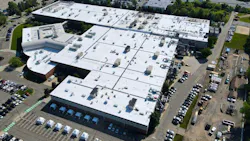

It took a while for the idea to take hold that building materials should be recycled at the end of their service lives. Although rooted in the environmental consciousness movement of the 1990s, many formalized recycling programs only began popping up in the last decade and a half. In that time, collective wisdom has developed to the point that, now, there is a firm belief that the ultimate recyclability of a material should be taken into account before construction drawings and specifications are finalized or a project ever breaks ground.
It’s known by a few names—“designing for recycling,” “designing for circularity,”“designing for the next life.” Whatever the name, it emphasizes that, at a project’s beginning, stakeholders should already be thinking of how certain materials can be recycled, and what new products they can be used to make. The philosophy dovetails well with the American Institute of Architects’ AIA 2030 Commitment, which strives to reach net zero emissions in the built environment. Also, many corporate environment, social, and governance (ESG) reporting requirements now incorporate green building certifications.
Intentional product selection today directly enables circularity and recycling feasibility tomorrow. A building material that always been ahead of the curve when it comes to green initiatives is PVC (vinyl) roofing membrane.
The Vinyl Roofing Division of the Coated Fabrics and Film Association is the professional advocacy organization for the PVC roofing industry. It works closely with two PVC industry experts who are helping shape the industry’s response for greater participation in recycling efforts. Brian Whelan is the owner of Roof Resources and past executive of Sika Sarnafil. Richard Krock is the owner of VyChlor Advisors, LLC, and former senior vice president of the Vinyl Institute. These key consultants both have more than four decades’ experience in the PVC industry and are thought leaders on roofing recyclability and sustainable roofing practices.
Whelan and Krock both describe PVC roofing as the “lead horse in the race” when it comes to roofing material ready-made for recycling. “When it comes to mechanically attached or induction welded thermoplastic single-ply roofing, nothing can compete,” said Whelan. “Other methods of installing single-ply roof membranes, such as adhered roofs, present additional challenges when it comes to separation for recycling. These systems are an area of continued focus as the industry explores opportunities to improve recovery and recycling. Mechanically fastened or induction welded PVC membranes can generally be removed more cleanly.”
“Bare back PVC single-ply membranes are literally designed for recyclability, or DFR,” said Krock. “It produces a stream of material that is prime for recyclability. All of its ingredients can be incorporated into new long-lasting materials.”
This ease of removal and significant yield pairs with an already-existing recycling infrastructure ready to remake old PVC roofing into things like new roofing membrane, paving spacers for landscaping, flooring, and more. It literally is designed for life.
Designing for … resilience
The longevity of PVC roofing membrane—at least 20 years—and its ease of removal contribute to the product’s overall resilience, which has become another major factor in deciding whether to use a particular building material. “The desire for resilience cuts across construction markets. Data centers, schools, hospitals, critical manufacturing facilities, they all build resilience into the roof system,” said Whelan. “Does the roof stay in place in extreme weather? If it does happen to become damaged, how quickly can it be fixed? Well, roofing like PVC, that is mechanically attached, can be repaired easily, recovered or taken off and recycled”.
“Even when the PVC membrane has reached the end of its service life, often the insulation below still has many good years left. This is effectively another green benefit of mechanically fastened or induction welded PVC single ply membranes, because it enables an existing material—the insulation—to remain in place even through a re-roofing project,” said Whelan. Salvaging the existing insulation has become so prized that some large property owners even schedule roof membrane removal a year or two before projected end of service life, just so they can be sure the insulation below is in good, dry condition.
What to do at the end of building material’s life has become more of a concern for architects. “Disposal is much more topical than in the past,” said Krock. “Retaining carbon value, which is incipient to PVC membrane, is a huge benefit when we start talking about responsible use of resources. Being able to recapture those resources is becoming paramount.”
Help is a click away
The Vinyl Roofing Division has a number of resources on its website (https://vinylroofs.org/) to promote recycling of the industry’s products. Whelan says of particular note for specifiers are the “PVC Roof Recycling Guide Specifications & Suggested Bid Line Item” (https://vinylroofs.org/sustainability/post-consumer-recycling/#specs). Both of these are reference tools for specifiers and consultants working on reroofing projects.
“It is a two-pronged approach,” said Whelan. “First, there is recommended spec language that specifiers can place in their re-roofing bid package. Second is a recommended bid line item that they can add to their re-roofing bid form. Breaking out cost for bundling and packaging the mechanically attached or induction welded single-ply membrane allows the building owner to make an informed decision”.
The Vinyl Roofing Division has also prepared a four-minute animated video that fully explains the removal-and-recycling process (available at vinylroofs.org).
The added value of ‘cool’
A PVC roofing membrane’s environmental value is not solely tied to its ultimate recyclability. White PVC membrane is also considered a “cool roof,” meaning it can reduce a building’s energy consumption. It all comes down to reflectivity rates, meaning how much the roof reflects solar energy away from its surface. Generally, the higher the reflectivity rate the better.
In urban areas, roofs can account for 35% of total surface area, so using cool roofs can significantly reduce the impact of what are known as urban heat islands (UHI), a phenomenon in which cities can experience daytime temperatures 7 degrees higher than rural areas.
Earning credits
In addition to their clear environmental positives, choosing a cool roof like PVC membrane carries real corporate benefit. “The studies and empirical data are clear,” said Krock. “When project stakeholders use green building materials, it becomes a win-win situation for everyone involved.”
He points to estimates that show LEED buildings have a 4.1% higher occupancy rate than noncertified buildings (Energy Star buildings are a similar 3.6% higher). LEED certification has several levels, from certified to platinum; there is an average 3% increase in rent for each increase in certification level. Also, green buildings can sell for 16% more than conventional buildings.
“Green Building Initiative, Green Globes, LEED, and BREEAM [Building Research Establishment Environmental Assessment Method] all award points for using lower-carbon recycled-content products,” said Krock. “I always advise checking their individual websites to see what’s available and how their rating systems can positively impact construction projects.”
Ultimately, designing for life means thinking of a building as a completed goal. From energy efficiency and resilience to recyclability and resource recovery, the choices made at the design table can have lasting environmental and economic impacts. Single-ply PVC roofing membranes demonstrate how a material can deliver value throughout its service life while also being positioned for a productive next life.
By considering what will one day happen to building materials—before they are ever installed—architects, owners, and contractors can move closer to a truly circular built environment, one in which today’s materials become tomorrow’s resources.