Garrett Herbst Explains AI-Driven Innovation in Architectural Design and Workflow
Key Highlights
- AI models like LLMs and Diffusion Models are transforming architecture by enabling faster data analysis and real-time visualizations.
- Herbst’s team builds custom scripts within platforms like Grasshopper and Dynamo to automate repetitive tasks and enhance design flexibility.
- The firm’s internal AI infrastructure allows secure analysis of sensitive data and development of tailored AI tools for specific project needs.
- Existing tools such as TestFit and Hypar are integrated to accelerate site studies and conceptual planning, improving project efficiency.
- Herbst emphasizes that AI-driven automation and customization foster greater creativity, innovation, and competitive advantage in architectural practice.

If there was one word that dominated 2025, a strong case could be made for AI. It captivated conversations of the tech-forward and the tech-averse alike, pondering what this new technology was, what it could do, and the benefit or harm it could bring. At the Charlotte office of architectural firm Little Diversified Architectural Consulting, Garrett Herbst, AIA, NCARB, thinks about the impact of AI in architecture daily. It is, in fact, part of his job as he spearheads the integration of technology and AI within the firm’s workflow and designs.
Regarding this integration, Herbst explains that artificial intelligence is generally grouped into two model types:
-
Large Language Models (LLMs). “These natural language processing tools allow us to analyze and synthesize massive amounts of text-based data. We use them for many applications like finding information within complex code or zoning documents, summarize hours of visioning or brainstorming sessions, or analyzing datasets like hundreds of Google reviews to uncover design insights for clients.”
-
Diffusion Models. “Because architecture is inherently visual, these image-based models have been transformative. They enable us to generate visual outputs from text, sketches, drawings or even physical models. In a matter of minutes, we can create early concept imagery to capture a project’s essence or produce real-time renderings to help our teams and clients visualize design decisions faster and with greater clarity.”
To help benefit from these capabilities, Herbst started an Emerging Tech CoLab to develop an internal AI server capable of running local Diffusion and Large Language Models. This infrastructure enables the architects to securely analyze sensitive project data, such as contracts and emails, and experiment with custom Diffusion models tailored to Little’s design language.
While architects and designers have a wide range of good quality design and modeling apps available to them, Herbst explains that in some cases, the efficiency and flexibility inherent in software can be limiting.
“By building custom parametric scripts, we can automate repetitive tasks, streamline complex processes and uncover new design possibilities. ‘There’s a script for that’ reflects a mindset that if a task is slowing you down or constraining your creativity, there is likely a script that can make it better,” he says.
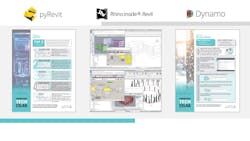
Herbst’s team has been building up a library of custom scripting tools that directly integrate into modeling software. The scripts are primarily built within node-based platforms such as Grasshopper for Rhino and Dynamo for Revit.
“For example, one script automatically generates parking layouts based on site boundaries and adjustable parameters like stall width, depth, and drive aisle dimensions. What previously took a few hours to test multiple layout options can now be completed in minutes and adjustments can be made instantly as design parameters evolve,” he says.
In general, existing tools are evaluated through a cost-benefit analysis, and in many cases, are found to be effective and useful. For instance, the team has identified TestFit as a great way to accelerate site yield studies and Hypar supports conceptual space planning.
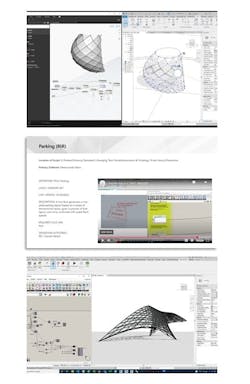
At the same time, in cases where custom workflows offer unique value or integration opportunities, the Emerging Tech group develops and maintains those tools in-house to enhance flexibility and control.
From simple automation scripts to advanced AI models, Herbst finds it rewarding to see how these customized tools are meaningfully improving workflows, both in his firm and amongst colleagues at the American Institute of Architects, where he is an active member.
“I am proud that Emerging Technologies plays a direct role in helping our teams fulfill that promise by enhancing creativity, efficiency, and innovation across the firm,” he shares.