Replacing Tropicana Field's Iconic Cable-Supported Dome: A Case Study in Engineering Resilience
Key Highlights
- Tropicana Field's roof was the second-largest cable-supported domed structure when built in 1990, notable for its tilted, aerodynamic design that withstands hurricanes.
- Hurricane Milton in 2024 caused significant damage, prompting a swift evaluation and replacement of the aging PTFE membrane roof.
- The new roof utilizes Serge Ferrari’s Tenseo Xtrem GF 7000 fabric for durability, weather resistance, and improved light transmission.
- Modern building codes required the replacement to withstand wind speeds of at least 155 mph, which the original design exceeded, simplifying compliance.
- The project balanced technical performance with aesthetic and functional considerations, such as natural lighting and visibility for players, ensuring the stadium’s operational integrity.
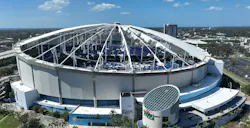
The cable-supported, domed roof at Tropicana Field, home of the MLB’s Tampa Bay Rays, has grabbed headlines over the years for many reasons.
Originally designed by the architecture firm HOK Sport (now Populous), in collaboration with Lescher & Mahoney Sports, and Criswell, Blizzard & Blouin Architects, it was recognized as the second-largest, cable-supported, domed roof in the world, when it opened in 1990. Covering six acres, it was smaller than only the Georgia Dome, which remained the largest until its demolition.
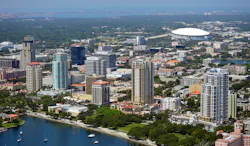
Beyond it’s size, the roof is notable for its tilted shape. Sloped at 6.5 degrees, the structure makes a dramatic drop from 225 above second base to 85 feet above the centerfield wall. The angle reduced the interior volume, making it more cost-effective to cool through the Florida summers, and improved the roof’s ability to withstand hurricanes. The aerodynamic shape allows fierce winds to glide up and over the structure and minimizes lift.
The notable roof successfully withstood Florida weather for nearly 35 years. Then, in October 2024, Hurricane Milton hit Tampa Bay and its 100 mph winds nearly ripped the entire roof off. That’s where this story starts.
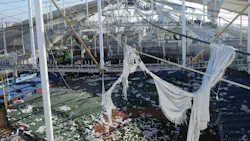
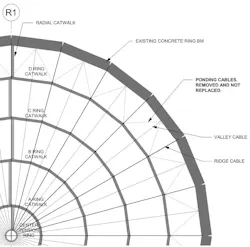
Geiger Engineers evaluated the damage. They found the primary cable dome structure to be intact and serviceable. The secondary ponding cables, which span under the outer fabric to limit the ponding of water on the surface, were damaged beyond repair, but did not need to be replaced. 18 of the dome’s 24 fiberglass panels were destroyed.
This was not a reflection of the original Serge Ferrari PTFE membrane roof. It has performed well for nearly 35 years. The roof had reached the end of its service life and had retained the majority of its tensile strength, but the aging process had significantly reduced the membrane’s tear strength and increased its brittleness, making the fabric more prone to localized punctures and tears.
It had been determined that the roof remained serviceable prior to the storm event, but replacements were being discussed. As it happened, Mother Nature sped up the replacement process.
“The original (Serge Ferrari PTFE) roof had successfully performed for nearly 35 years, providing confidence regarding long-term durability and behavior,” explained Eric Dahl, P.E., S.E., principal Geiger Engineers, Suffern, N.Y. Considering Serge Ferrari PTFE as a replacement offered several benefits. "It represented a replacement-in-kind material with well-understood structural properties, optical performance, and fire resistance."
Creating a New Tensile Roof…Fast
The roof fabric was required to be non-combustible (as defined by the Code) by the City of St. Petersburg Fire Marshall. Only PTFE-coated fiberglass fabrics meet this requirement. “We could have pursued a variance, but there was no time to do so,” said Dahl.
The new PTFE roof needed to be reconstructed quickly in order to get the stadium reopened for the 2026 baseball stadium.
The team specified Serge Ferrari’s newer Tenseo Xtrem GF 7000 system, a woven fiberglass fabric treated with PTFE Smart Deep Technology and sealed with a Pro Shield Max treatment, a fluorinated ethylene propylene (FEP) topcoat that gives the membrane its smooth, weather-resistant surface.
“The smooth FEP surface allows rainwater to naturally wash away dirt over time, which is part of what supports the long-term aesthetic stability of the system,” said David Peragallo, Serge Ferrari’s Senior Specification Manager for North America.
Nearly 45,000 square meters of membrane material were needed for the 24 roof panels. Each panel spans 330 ft. and weighs approximately 5,000 pounds.
“Manufacturing was completed at Serge Ferrari Group’s facility in Germany before the material was shipped to Enclos Tensile Structures for panel fabrication and assembly,” said Peragallo.
Climate considerations and safety standards have changed a lot in 35 years. According to Dahl, current building codes require higher 155 mph strength level (factored) wind. Geiger Engineers converted the original fastest-mile wind speed to the modern 3-second gust format and strength-level design basis. They demonstrated that the original design was equivalent to a 163 mph design-wind—exceeding the current code requirement. This satisfied the local building authority and eliminated the need to strengthen the existing primary structure and exterior cladding for the roof replacement.
A Visual Background for Baseball
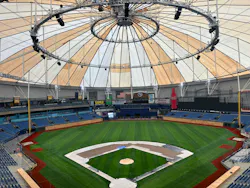
The color and light transmission properties of the new roof were also causes for concern. Where the original roof had a liner, the new roof was a single-layer fiberglass composite membrane.
The removal of the liner was expected to increase the amount of natural light that would fill the stadium during games. The team and the MLB wanted to be certain that it would not be difficult for players in the outfield to track the white baseball, in the air, across the bright white fiberglass roof.
“The light transmission (and color) of the new roof fabric were not a Code of Building Department concern, but were significant concerns of the Rays and MLB with respect to its potential impact on a player’s ability to track balls,” said Dahl.
The Hennessey Construction and AECOM Hunt team had a daylight study performed for the variants of the candidate PTFE-coated fiberglass material available to meet the project’s schedule. This was submitted to the Rays and MLB with the result that the single skin (no liner) standard white product was approved.
When first installed, the fabric panels have a beige color but they will fade to white over time.
In an interview given to Fox 13 Tampa Bay, Peragallo explained, “The membrane will react when exposed to UV light. The membrane will become transparent. Of course, it’s not totally transparent, because otherwise you will have too much light and too much sun in the building. The final color will give you the right balance between transparency and shading.”
Lesson in Major Tensile Roof Restoration
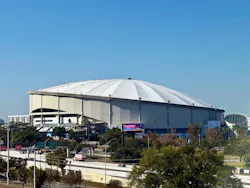
While challenging and difficult, the successful replacement of the fabric roof preserved a major cable dome structure and enabled the stadium to meet modern engineering expectations and operational requirements.
The technical case study was written up and presented by Dahl and his colleagues at the Annual Symposium of the International Association for Shell and Spatial Structures.
“The experience provides valuable lessons for the future assessment, rehabilitation, and resilience planning of aging tensile membrane structures exposed to extreme environmental hazards,” concluded Dahl.